Sesamouse is most exciting when it's enabling
other applications to use the Magic Mouse for multitouch.
One of the most frequent requests has been to get rid of the Dock icon.
Starting with version 1.2, Sesamouse sends real Magic Mouse pinch zoom and rotate gestures
from the background, with a menu bar icon instead.
While Sesamouse's primary feature is real multitouch gestures and NSTouch information for Cocoa apps,
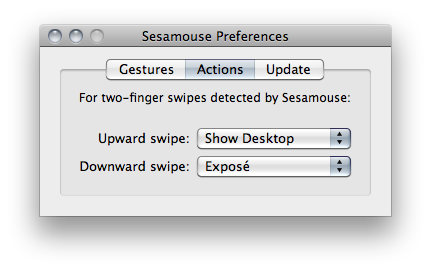
it can be very handy to trigger Exposé or other Mac OS X features from the mouse.
So Sesamouse 1.2 also adds optional support for a few commonly-requested system hotkeys:
Mighty Mouse users might still miss activating these features in "hold" mode,
but these gesture shortcuts are easy to set up for those who find them helpful.
Rather than having fewer productive features than the previous model,
the Magic Mouse can provide real multitouch and some handy shortcuts —
when used with Sesamouse, that is!
If you've found Sesamouse useful, don't forget to donate.
We're still asking on behalf of Haitian small businesses, because the work there isn't done.
If you haven't found Sesamouse useful, please let us know why.
Along with a minor update, we've made a video screencast demonstrating how Photon Star makes rating fun and focused:
Because of an issue with automatic updates for full screen apps, you'll need to manually trigger
"Check for Updates..." in the Photon Star menu to get the 1.0.1 fixes.

One thing I enjoy most about Photon Star's workflow
(besides rating pictures with a remote!) is that it lets me focus on one rating level at a time.
I've found it helpful to keep in mind a potential "use" for photos of a given star rating,
along with some rough guidelines to work through each rating stage.
The logic I follow goes something like this:
Rating
Emotionally meaningful?
Techically correct?
Potential action
5
Definitely
Probably
Make prints
4
Yes
Maybe
Share online or with family
3
Somewhat
Maybe
Enjoy in screensaver or slideshow
2
No
Not really
Keep for reference
1
No
No
Reject
I really only use these personal guidelines as a fallback when I have trouble making a spontaneous decision.
If my criteria dictate 2 stars for a photo but I'd rather not be so harsh, it gets 3 stars.
I rate for my own enjoyment and benefit, and individual ratings are easy to adjust if I feel differently later.
It's more helpful to rate all my photos approximately, than to fret about one photo being a star off.
My own rating guidelines in practice
Here's a one-star picture from a recent trip to Portland:
Even if the road sign hadn't zipped between my lens and the Biggs bridge,
the exposure caught significant camera shake and I had a bit of the car's dashboard in the foreground. Yuck.
I gave this photo two stars:
It's still not a great photo by any means, but...I dunno...there's a cool barge with a crane on the river?
(I did have iPhoto include the places assigned by Geotagalog when
I exported the examples from this trip, if you're curious where they were taken!)
There's a lot I like about this photo, so I'm not sure why I initially gave it three stars instead of four.
I do end up with pictures like this every trip through the mountains, so maybe I was just bored with it when I got home.
I think I'll bump it up to four stars (it's easy as pressing Cmd-4 in iPhoto) now that the scene feels adventuresome again.
Why does this next one get four stars?
It was tough getting good photos on a grey morning through the fogged up windows of the back seat of the car,
but I think the muted colors and unbalanced composition do quietly capture something that might be worth sharing.
When I get to the beginning Photon Star's last stage, I just exit rating and leave them all at 4 stars.
I'm glad I switched to black and white for this one to work with the cloudy day,
and there are some intriguing shapes and textures that could potentially merit this one five stars.
Forming your own rating criteria
Realize that iPhoto was built to ask "How good is this photo?" and make you choose one of its five answers.
(Six, if you're still trying to make "no stars" mean both "reject" and "not rated"!)
iPhoto could have left it at thumbs up or down, or it could have split lighting/exposure/subject/effort/pizzazz
apsects into a scoring rubric,
or it could have made you color a diagram of your feelings towards each photo, or...—
a scale from 1 to 5 stars is the reasonable design compromise we have when rating for iPhoto!
In my head, I rate my photos more like this:
Rating
Potential action
Whoops!
Wish it weren't so but accept another rating.
Meh...
Make mental note to think harder.
Ick!
Make mental note to snap smarter.
Hmm.
Appreciate the memory.
Ooh!
Stare. Enjoy. Repeat. Share.
(These don't have any direct correspondence to iPhoto's star ratings, so I use the other chart instead.)
You don't have to work this all out before you can start organizing your iPhoto library by ratings.
In fact, the best way to create your own rating chart is by using Photon Star to rate a few different sets of photos.
Use iPhoto's smart albums or search field options to enjoy your work. Note any "mistakes" you see later after a fresh look.
Watch how you end up sharing and what you tend to do with photos from each rating level.
Then the next time you use Photon Star to catch up on rating, pay attention to what meanings the stars have for you.
I'd love to hear what terms you use when you think about your photos' quality.
Is the way you match with iPhoto's star ratings similar to mine?